Gemini 4 Argon vs Gemini 3.8 Flash: 2.7× the Price, Yet Cheaper? A Three-Task Test
The same three office tasks sent through the Gemini API and graded by code: Flash scored 15/15 and Argon 14/15, yet Argon was cheaper and faster despite 2.7 times the price per token. Official prices, method and limits.
Gemini 4 Argon, Google's strongest model and newly available on the API, costs 2.7 times as much per token as Gemini 3.8 Flash. So for everyday office work, what do you get for paying more? This test gives both models the same three tasks used in our Claude Haiku 5.5 vs Sonnet 5.5 test through the Gemini API, grades every answer with code against answers worked out in advance, and measures real time and cost. The result runs against the price list: Argon came out cheaper and faster, but missed one check.
Tested on 14 October 2026, calling the Gemini API directly with
gemini-3.8-flashandgemini-4-argon, each at its default thinking level. Each task ran once, so this is a real-world observation, not statistics. The tasks use made-up data. Prices come from the official Gemini API pricing page (updated 13 October 2026, paid tier).
Watch the real test run (Vietnamese narration): https://youtu.be/ygVlHxkqv7g
Two models, 2.7× apart in price per token
| Gemini 3.8 Flash | Gemini 4 Argon | |
|---|---|---|
| Input price (per million tokens) | $0.75 (until 31 Dec 2026), $1.50 from 1 Jan 2027 | $2 (introductory, until 30 Nov 2026), $4 from 1 Dec 2026 |
| Output price, thinking included (per million tokens) | $3.75 (until 31 Dec 2026), $7.50 from 1 Jan 2027 | $10 (until 30 Nov 2026), $20 from 1 Dec 2026 |
| Free tier | Yes | No |
| Google's description | Its most intelligent Flash model, for long-horizon software engineering, autonomous agents and complex enterprise workflows | Its flagship reasoning model, with a 1 million token context window |
Both are listed as "Stable" on the Gemini API models page. According to the pricing page, Argon is not available on the Free tier or on the Google AI Pro plan. Sources: Gemini API pricing, models page. For background on Argon, read Gemini 4 Argon explained.
How the test worked
- Three office tasks, identical to the Haiku vs Sonnet test, with answers worked out before running:
- Read a messy email and extract invoice details as JSON. Traps: a mistyped amount that was later corrected, a former company name, a due date written in words.
- Work out tiered sales commission for 5 staff: 2% / 4% / 6% by band, plus a 1 million dong bonus for sales of 150 million or more with no returned orders. Traps: Dũng at exactly 200 million, Hạnh at 149.5 million (500,000 short of the bonus), Chi with enough sales but one returned order.
- Write a reply to a customer whose order was late: at most 120 words, a 10% discount code, no promised delivery date, ending with the hotline.
- The same prompt sent through the Gemini API to each model, at its default thinking level.
- Code grades every item: 5 invoice fields, 6 commission figures, 4 email conditions. 15 items per model.
- Real measurements: time from request to response, token counts reported by the API (output includes thinking tokens), and cost from the price list.
Results task by task
Task 1: extracting invoice details
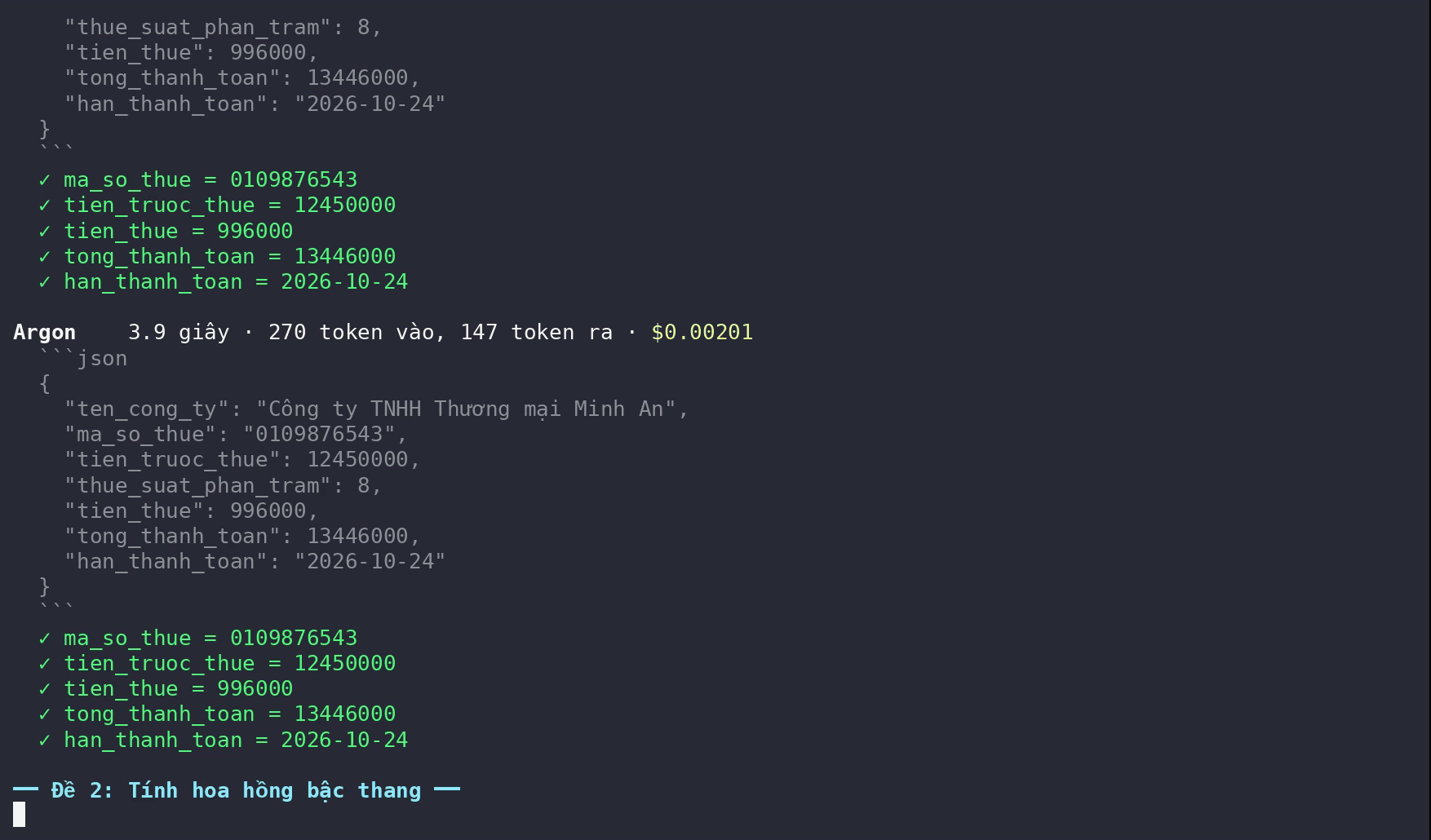
Both returned the same JSON, with all 5 fields right: tax code, pre-tax amount of 12,450,000 dong (not the mistyped figure), tax of 996,000 dong, total of 13,446,000 dong, due date 24/10/2026. Times were almost the same: Flash 4.2 seconds, Argon 3.9 seconds. The difference was output tokens: Flash used 490, Argon 147, for an identical answer.
Task 2: tiered commission
Both got all 6 figures right, neither wrongly gave Hạnh the bonus, and both followed "No explanation" by returning only the table. But Flash took 8.1 seconds and 1,322 output tokens, while Argon took 4.6 seconds and 234.
Task 3: replying to the customer
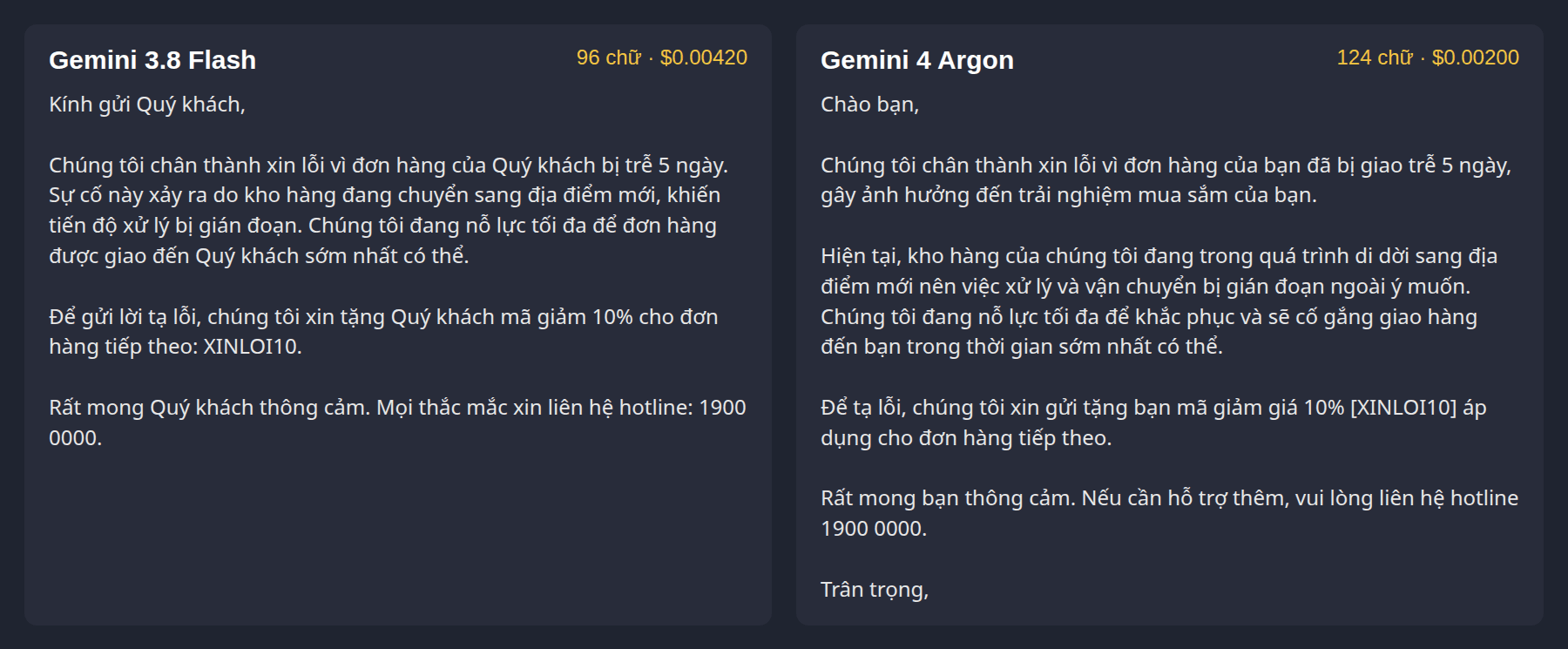
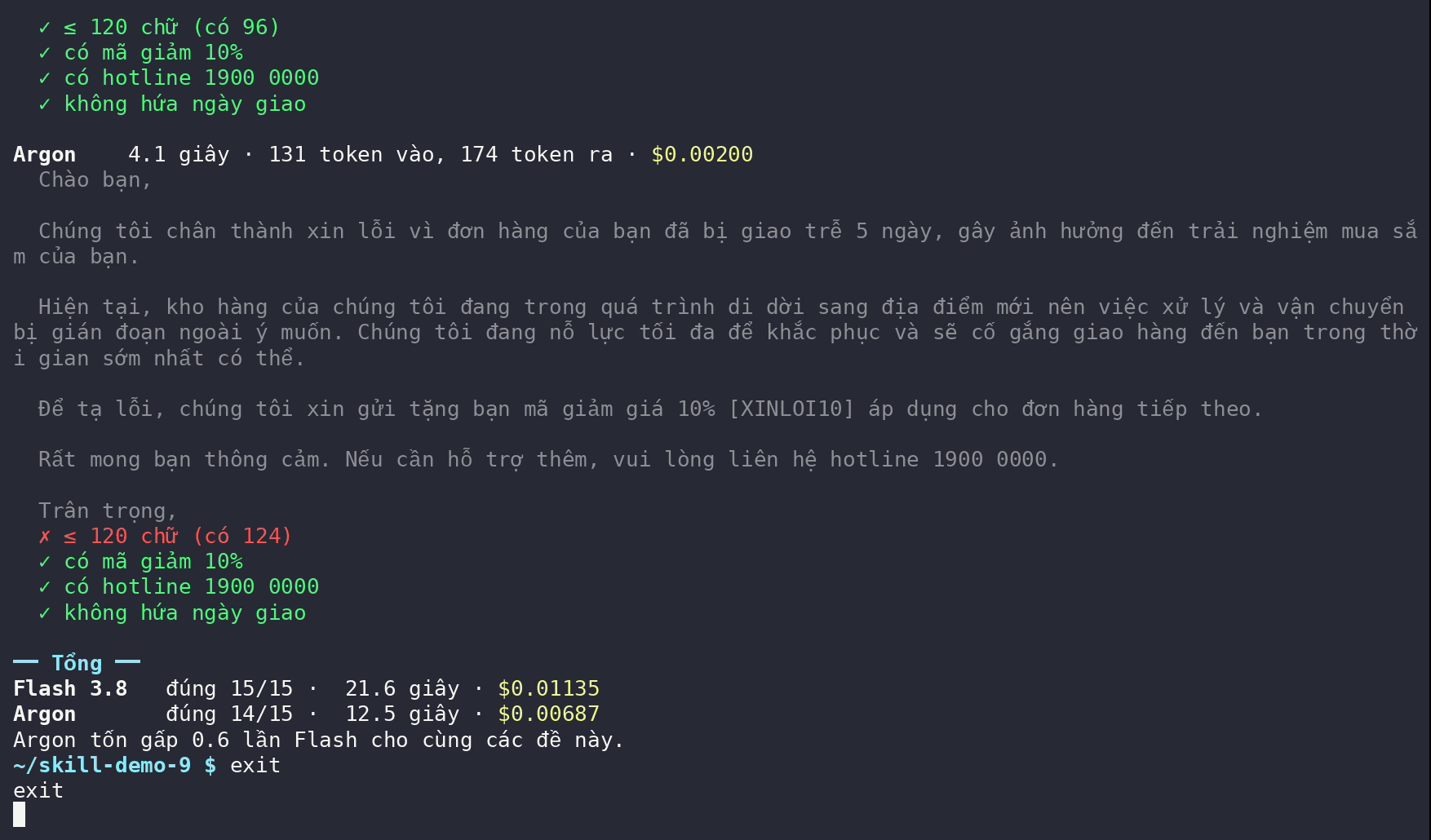
This was the only task where the outcome differed. Flash wrote 96 words and passed all 4 checks. Argon wrote 124 words, over the 120-word limit, and also put "Trân trọng," ("Kind regards") after the hotline even though the task said to end with the hotline (the code only checks that the hotline is present, not where). Both included the 10% code and promised no delivery date.
Summary: Argon cheaper and faster, but missed one check
| Gemini 3.8 Flash | Gemini 4 Argon | |
|---|---|---|
| Correct (graded by code) | 15/15 | 14/15 |
| Total time, 3 tasks | 21.6 seconds | 12.5 seconds |
| Total output tokens, 3 tasks (thinking included) | 2,912 | 555 |
| Total cost, 3 tasks | $0.01135 | $0.00687 |
| Doing these 3 tasks 1,000 times (scaled from the measurement) | about $11.4 | about $6.9 (from 1 Dec 2026: about $13.7) |
Why did the more expensive model cost less?
You pay per token, and thinking tokens are billed as output tokens. In this run Flash used 490, 1,322 and 1,100 output tokens across the three tasks; Argon used 147, 234 and 174. The visible answers were about the same length (task 1 produced two identical JSON blocks), so the gap is in the thinking: Flash thought far more before answering. Argon's price per token is 2.7 times higher, but it used about 5 times fewer output tokens, so its total came out lower.
That can change when prices change: from 1 December 2026 Argon's price doubles, and the same token counts would cost about $0.0137, slightly more than Flash. Flash's price doubles from 1 January 2027.
The comparison code
The part of the script that calls the Gemini API and works out the cost (Python, httpx). Output tokens add candidatesTokenCount and thoughtsTokenCount, because both are billed. Grading is the same as in the Haiku vs Sonnet test: parse the JSON and compare each field (task 1), take the last number on each table row (task 2), count words and look for "10%", the hotline and any dates (task 3).
import time, httpx

PRICES = {"gemini-3.8-flash": (0.75, 3.75), "gemini-4-argon": (2.00, 10.00)}  # USD per million tokens

def ask(model: str, prompt: str, api_key: str):
    started = time.monotonic()
    reply = httpx.post(
        f"https://generativelanguage.googleapis.com/v1beta/models/{model}:generateContent",
        headers={"x-goog-api-key": api_key},
        json={"contents": [{"role": "user", "parts": [{"text": prompt}]}]},
        timeout=600,
    ).json()
    parts = reply["candidates"][0]["content"]["parts"]
    text = "".join(p.get("text", "") for p in parts if not p.get("thought"))
    used = reply["usageMetadata"]
    tokens_out = used.get("candidatesTokenCount", 0) + used.get("thoughtsTokenCount", 0)
    price_in, price_out = PRICES[model]
    cost = used["promptTokenCount"] * price_in / 1e6 + tokens_out * price_out / 1e6
    return text, time.monotonic() - started, cost
Limits of this test
- Each task ran once. Thinking token counts can vary a lot between runs, and so can cost and time.
- All short tasks with clear answers. Long, multi-step work, coding or large documents, where Google says Argon is strongest, were not tested.
- Prices are introductory and will change: Argon doubles from 1 December 2026, Flash from 1 January 2027.
Takeaway: don't pick a model by price per token
- Measure real cost on your own tasks. Price per token is only half the story; a model that thinks less can cost less despite a higher rate.
- For strict requirements (word counts, format, what the last line must be), write a few lines of code to check. Argon going over 120 words is exactly the kind of slip a quick read misses.
- Re-run when prices change. With the API, switching models is a one-line change to
model, so re-run your own test set whenever the price list moves.
Frequently asked questions
How much does Gemini 4 Argon cost on the API?
According to the Gemini API pricing page updated on 13 October 2026 (paid tier): $2 per million input tokens and $10 per million output tokens (thinking included), an introductory price until 30 November 2026. From 1 December 2026 it is $4 and $20. Argon is not on the free tier.
Is Gemini 4 Argon better than Gemini 3.8 Flash?
On the three short office tasks here: Flash got 15/15 items right, Argon 14/15 (its email went over the 120-word limit). Argon was faster and cheaper in this run. Long, multi-step work and coding were not tested.
Why did Argon cost less than Flash despite its higher price?
Because thinking tokens are billed as output. In this run Flash used 2,912 output tokens across the three tasks and Argon only 555, so even at 2.7 times the price per token Argon's total was lower ($0.00687 against $0.01135).
How can I compare two models myself?
Prepare a few tasks with known answers, send the same prompt to each model through the API, and let code compare the replies with the answers. Take token counts from the usageMetadata the API returns, remember to add thinking tokens, and work out cost from the price list.
Sources
- Gemini API — Pricing
Vendor page
- Gemini API — Models
Vendor document
- Google Gemini Blog: Gemini 4 Argon: our next era of frontier intelligence
Vendor page