Claude Haiku 5.5 vs Sonnet 5.5: 18× Cheaper, but Worse? A Three-Task Test
The same three office tasks sent through the API and graded by code: Haiku 5.5 and Sonnet 5.5 both scored 15/15, with Haiku faster and 18 times cheaper. Official prices, method and limits.
Claude Haiku 5.5 is listed at a twentieth of the price of Claude Sonnet 5.5. So for everyday office work, does the cheaper model fall short? This test gives both models the same three tasks through the API, grades every answer with code against answers worked out in advance, and measures real time and cost.
Tested on 13 October 2026 by calling the Claude API directly with
claude-haiku-5-5andclaude-sonnet-5-5, each at its default effort (Haiku: medium, Sonnet: high). Each task ran once, so this is a real-world observation, not a statistic. The tasks use made-up data and are written in Vietnamese. Prices come from Anthropic's official pricing page on the same day.
Watch the real run (Vietnamese narration): https://youtu.be/AqLwBZqVld8
Two models, a 20× price gap
| Claude Haiku 5.5 | Claude Sonnet 5.5 | |
|---|---|---|
| Input price (per million tokens) | $0.10 (prompts up to 100,000 tokens) | $2 |
| Output price (per million tokens) | $0.50 (prompts up to 100,000 tokens) | $10 |
| Anthropic's description | Released 7 October 2026. For high-volume, latency-sensitive tasks such as classification, extraction and routing | The best combination of speed and intelligence |
One Haiku 5.5 caveat: prompts over 100,000 tokens cost $0.50 input and $2.50 output per million tokens. Sonnet 5.5 keeps one price across its full 1M-token window. Sources: pricing and the Claude Haiku 5.5 page.
The test
- Three office tasks, with answers worked out by hand before running:
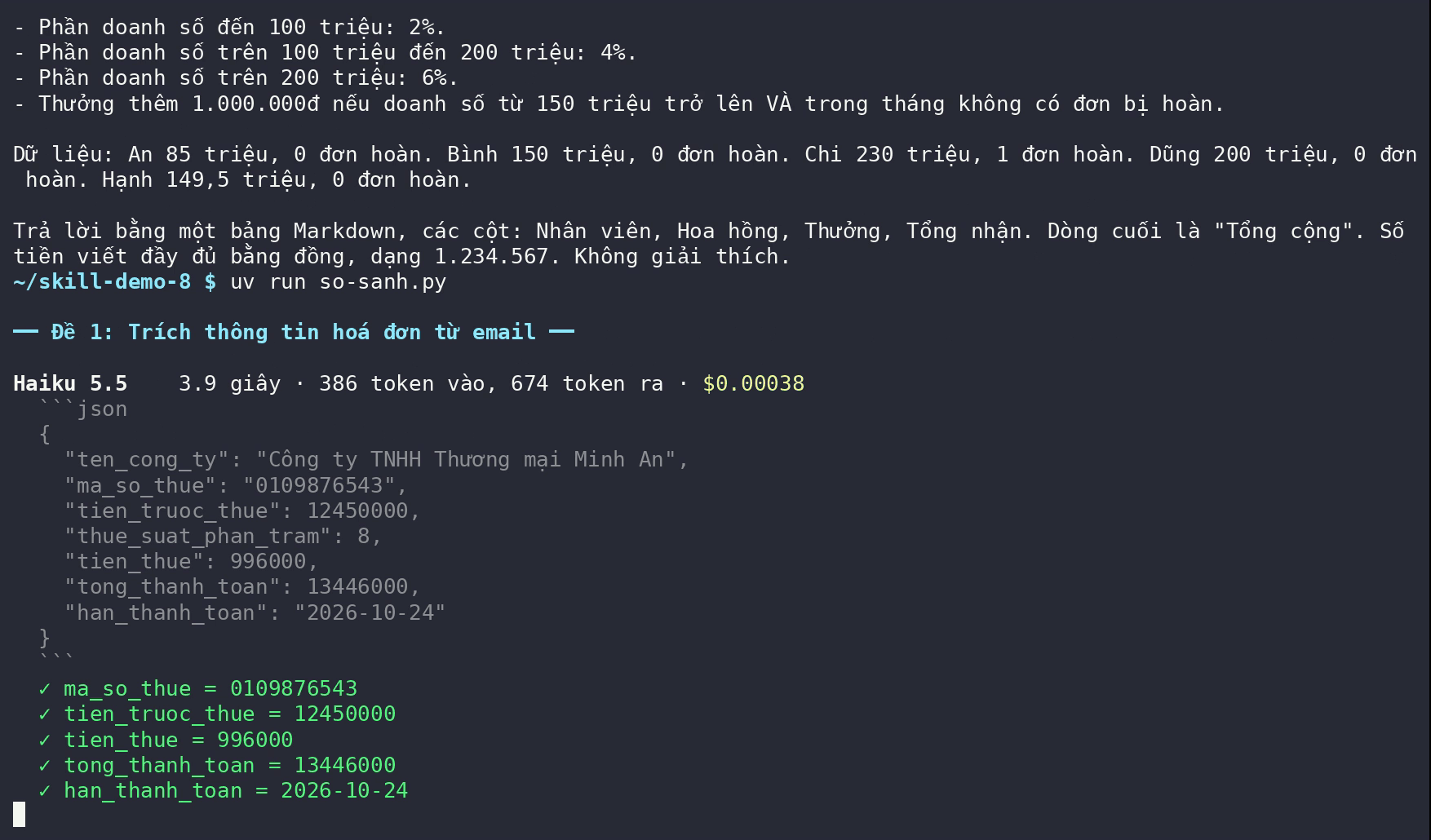
- Read a messy email and extract invoice details as JSON. Traps: a mistyped amount that was later corrected, an old company name, and a due date written in words.
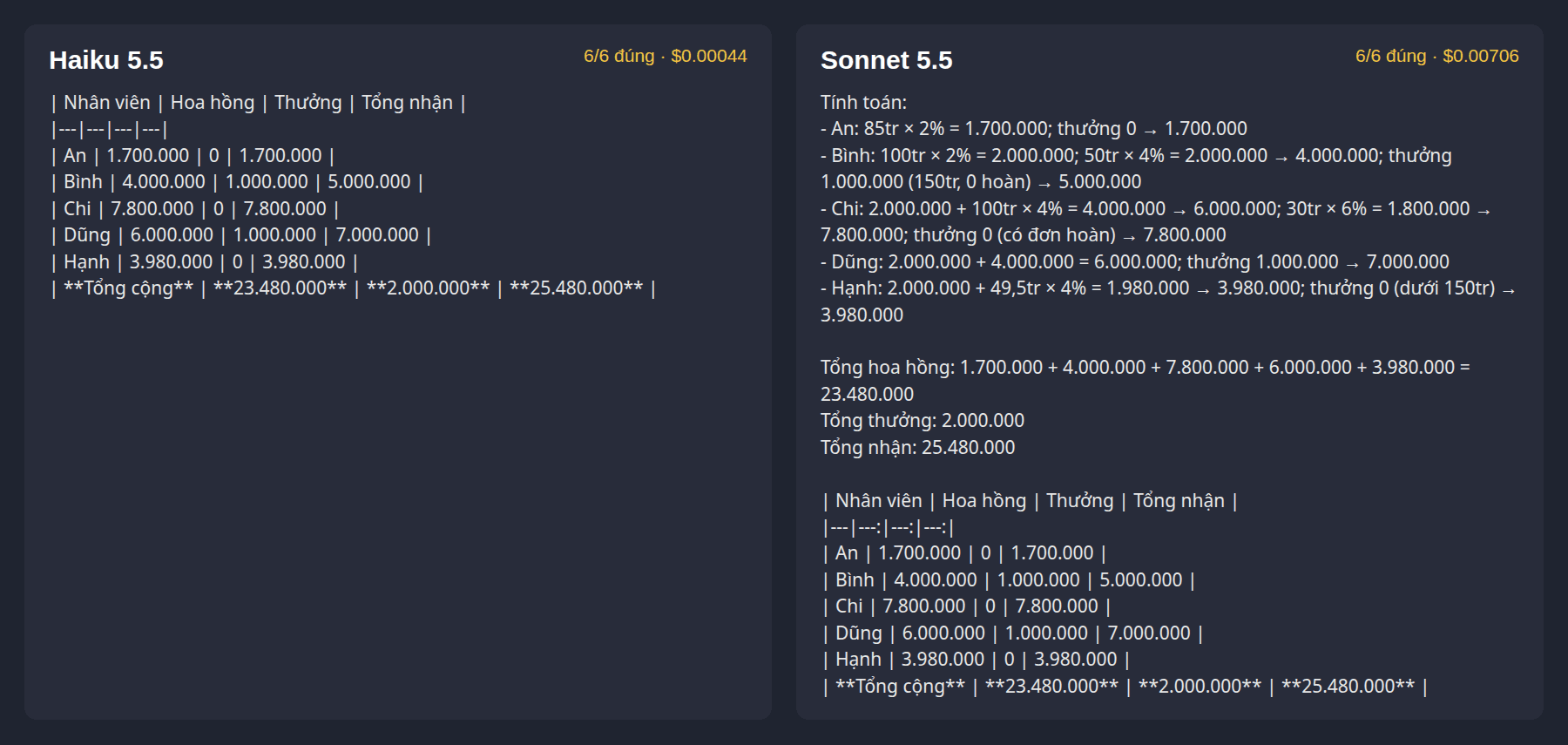
- Work out tiered sales commission for 5 staff: 2% / 4% / 6% by tier, plus a 1 million dong bonus for sales of 150 million or more with no returns. Traps: one person at exactly 200 million, one at 149.5 million (500,000 short of the bonus), and one with enough sales but a returned order.
- Write a reply to a customer whose order arrived late: at most 120 words, a 10% discount code, no promised delivery date, and end with the hotline.
- The same prompt sent to each model through the API.
- Code grades each item: 5 invoice fields, 6 commission figures, 4 email conditions. 15 items per model.
- Real measurements: time from request to response, token counts reported by the API, and cost from the price list.
Results by task
Task 1: invoice extraction
Both returned the same JSON with all 5 fields right: tax code, pre-tax amount 12,450,000 dong (not the mistyped figure), tax 996,000, total 13,446,000, due date 24 October 2026. Haiku took 3.9 seconds, Sonnet 5.2.
Task 2: tiered commission
Both got all 6 figures right and neither paid the bonus to the person 500,000 short. The difference was following the instruction "No explanation": Haiku returned only the table, while Sonnet wrote out the full working before the table.
Task 3: customer email
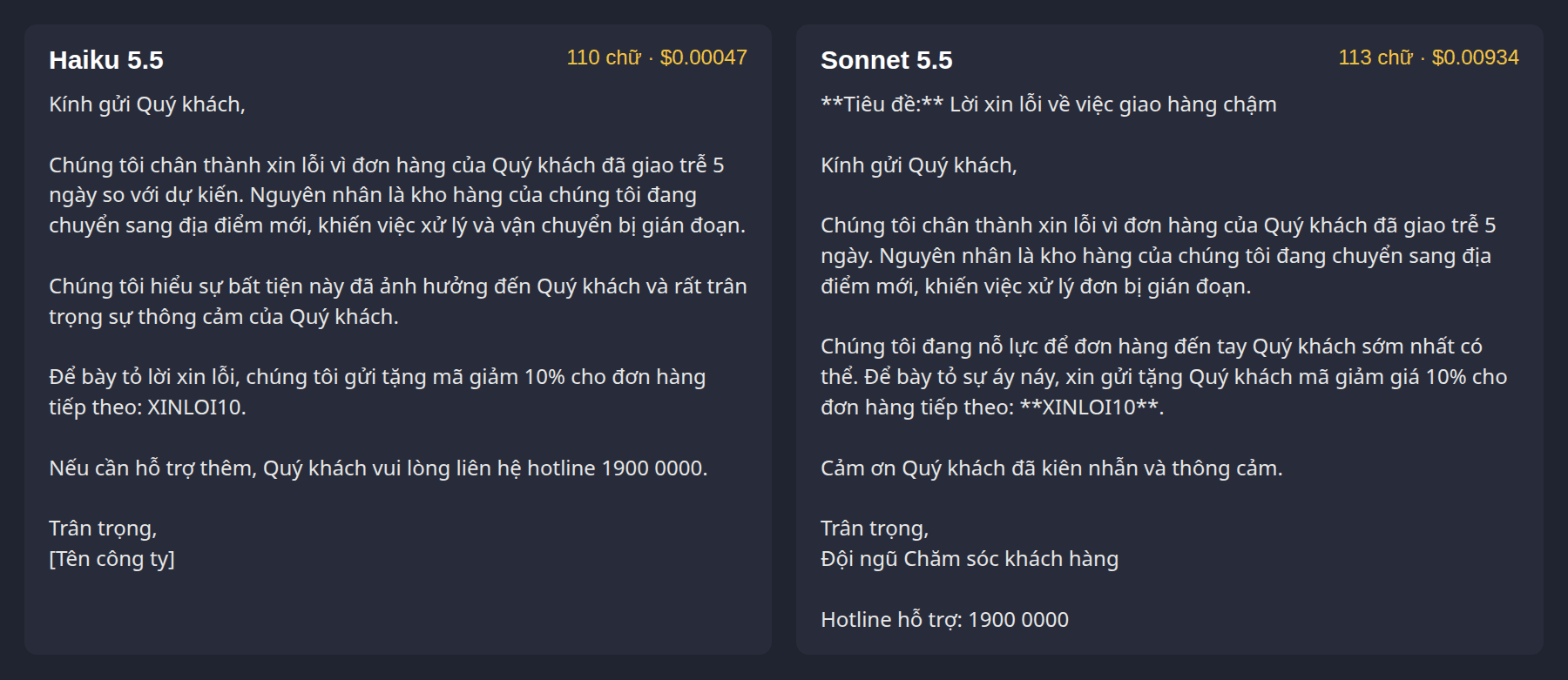
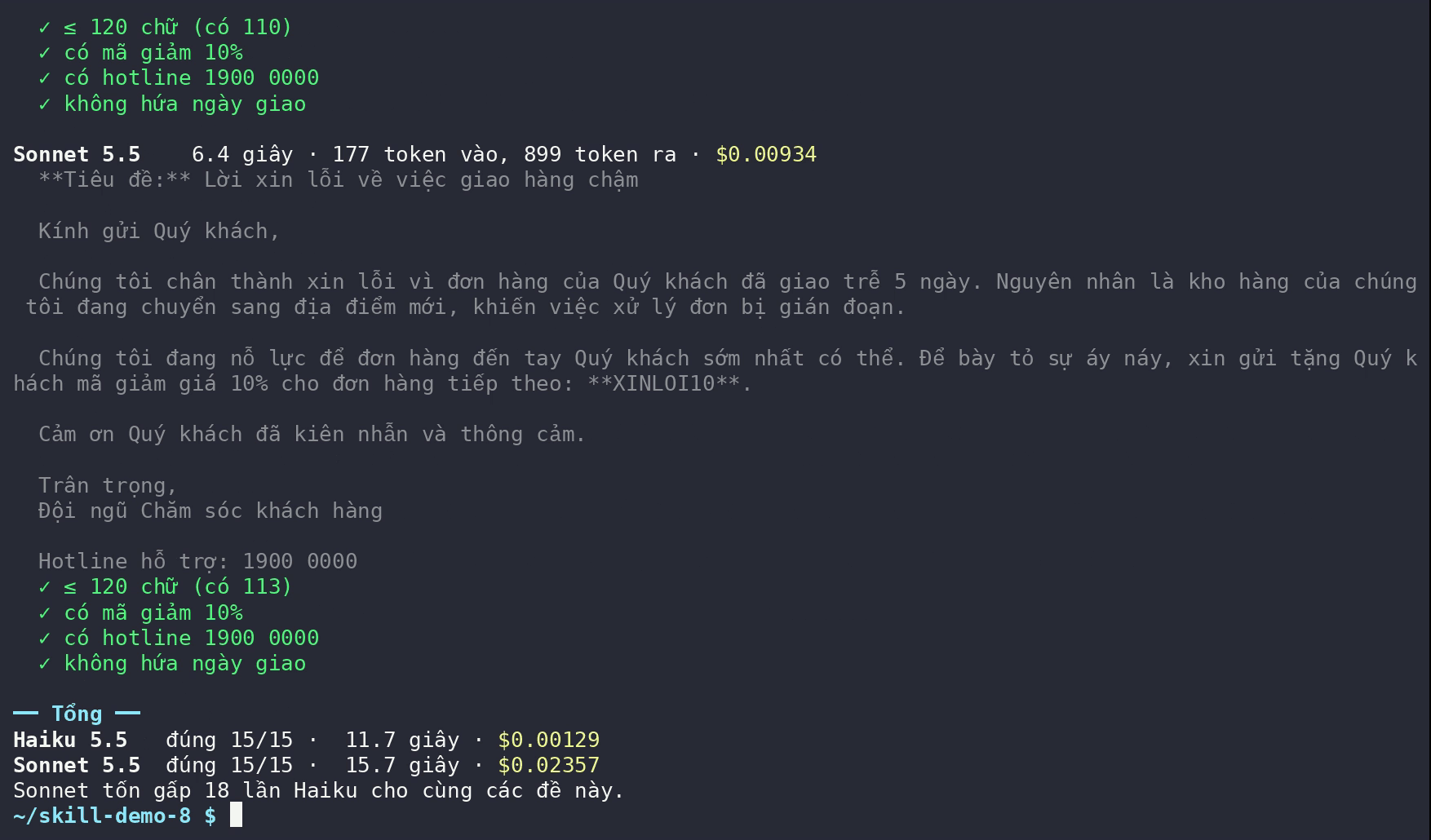
The two drafts are very similar: 110 and 113 words, both apologise, give the warehouse move as the reason, offer the 10% code and promise no date. Sonnet added a subject line and put the hotline on the last line as asked. Haiku put a "[Company name]" signature after the hotline.
Summary: equally correct, 18× the cost
| Haiku 5.5 | Sonnet 5.5 | |
|---|---|---|
| Correct (graded by code) | 15/15 | 15/15 |
| Total time, 3 tasks | 11.7 s | 15.7 s |
| Total cost, 3 tasks | $0.00129 | $0.02357 |
| These 3 tasks × 1,000 (scaled from the measurement) | about $1.30 | about $23.60 |
Sonnet cost 18 times as much rather than 20, because Haiku used slightly more output tokens (thinking included): 674, 800 and 909 tokens versus Sonnet's 640, 626 and 899.
The comparison code
The API call and cost calculation from the script used here (Python, httpx). Each task sends the same prompt to both models; a separate function compares the reply with the answer: parse the JSON and check each field (task 1), take the last number on each table row (task 2), count words and look for "10%", the hotline and any dates (task 3).
import time, httpx

PRICES = {"claude-haiku-5-5": (0.10, 0.50), "claude-sonnet-5-5": (2.00, 10.00)}  # USD / triệu token

def ask(model: str, prompt: str, api_key: str):
    started = time.monotonic()
    reply = httpx.post(
        "https://api.anthropic.com/v1/messages",
        headers={"x-api-key": api_key, "anthropic-version": "2023-06-01"},
        json={"model": model, "max_tokens": 8000, "messages": [{"role": "user", "content": prompt}]},
        timeout=300,
    ).json()
    text = "".join(b.get("text", "") for b in reply["content"] if b["type"] == "text")
    used = reply["usage"]
    price_in, price_out = PRICES[model]
    cost = used["input_tokens"] * price_in / 1e6 + used["output_tokens"] * price_out / 1e6
    return text, time.monotonic() - started, cost
Limits of this test
- Each task ran once. A rerun may word things differently.
- All tasks were short with clear answers. Long multi-step work, coding and large-document analysis were not tested; that is where a larger model usually has an edge, and it needs its own test.
- Very long prompts (over 100,000 tokens) make Haiku five times more expensive, narrowing the gap with Sonnet.
Takeaways: picking a model for repeated work
- Short, well-defined tasks (extraction, rule-based calculation, templated writing): try Haiku first. In this test it matched Sonnet, ran faster and cost 18 times less.
- Write a few lines of code to check the output, as this test does, so you know the cheaper model is good enough for your work.
- For harder work, compare on your own tasks. With the API, switching models is a one-line change to
model.
To use the Claude API with the credit included in a Max plan, see how to claim Claude Max API credits.
Frequently asked questions
How much does Claude Haiku 5.5 cost?
$0.10 per million input tokens and $0.50 per million output tokens for prompts up to 100,000 tokens; $0.50 and $2.50 above that. The Batch API is 50% off. Prices from Anthropic's official page on 13 October 2026.
Is Haiku 5.5 worse than Sonnet 5.5?
Not on the three short office tasks here: both scored 15/15 items graded by code, and each slipped once on formatting. Long, multi-step work and coding were not tested.
How much more does Sonnet cost than Haiku?
20 times by the price list, for prompts up to 100,000 tokens. In this test the actual total differed by 18 times ($0.02357 versus $0.00129), because Haiku used slightly more output tokens.
How can I compare two models myself?
Prepare a few tasks with known answers, send the same prompt to each model through the API, and let code compare the replies with the answers. Record time and the usage token counts from the API response to work out cost from the price list.
Sources
- Claude API — Pricing
Vendor page
- Claude Haiku 5.5 — model overview
Vendor document
- Claude models overview
Vendor document